Artificial Intelligence has already changed the way businesses work. Chatbots answer customer questions. AI tools write emails. Automation software moves files from one system to another. But now, businesses are entering a new phase.
Instead of simply following commands, AI agents can understand goals, make decisions, complete multiple tasks, and even work with other AI agents to solve complex problems. That is why many experts believe AI agents are the next major step in business automation.
According to a 2025 McKinsey Global Survey, 88% of organizations already use AI in at least one business function. More importantly, 39% are experimenting with AI agents, while 23% have started scaling them across parts of their businesses.
Businesses are no longer asking whether they should use AI. They are asking how quickly they can build AI agents that actually perform work.
What Is an AI Agent?
An AI agent is an intelligent software system that can complete tasks with minimal human involvement. Unlike traditional automation tools, an AI agent doesn’t simply follow a fixed set of rules.
Instead, it can:
● Understand a goal
● Break the goal into smaller tasks
● Collect information
● Make decisions
● Learn from feedback
● Work with other software or AI agents
● Complete the task and report the results
Think of it as giving work to a capable digital employee instead of using a simple software tool. For example, instead of asking software to send an email, you can ask an AI agent: “Find customers who haven’t purchased in six months, create personalized offers, email them, and prepare a report by tomorrow.”
The AI agent plans every step and completes the work automatically.
AI Automation vs AI Agents
| Traditional Automation | AI Agents |
|---|---|
| Follows fixed rules | Understands goals and context |
| Performs one task | Handles multiple connected tasks |
| Needs manual updates | Learns and adapts from feedback |
| Cannot make decisions | Makes limited decisions independently |
| Best for repetitive work | Best for dynamic business workflows |
This shift is why AI agents are becoming one of the biggest technology investments for businesses in 2026 and beyond.
Why AI Agents Are Becoming So Popular
Several technologies have matured at the same time.
Large Language Models (LLMs), cloud computing, workflow automation, APIs, and enterprise data platforms now work together. This allows AI agents to perform jobs that previously required human employees.
According to Deloitte, more than 80% of Indian organizations are exploring autonomous AI agents, and 70% want to use generative AI for automation. Meanwhile, Microsoft describes AI agents as the next generation of business applications because they can automate complete workflows instead of individual tasks.
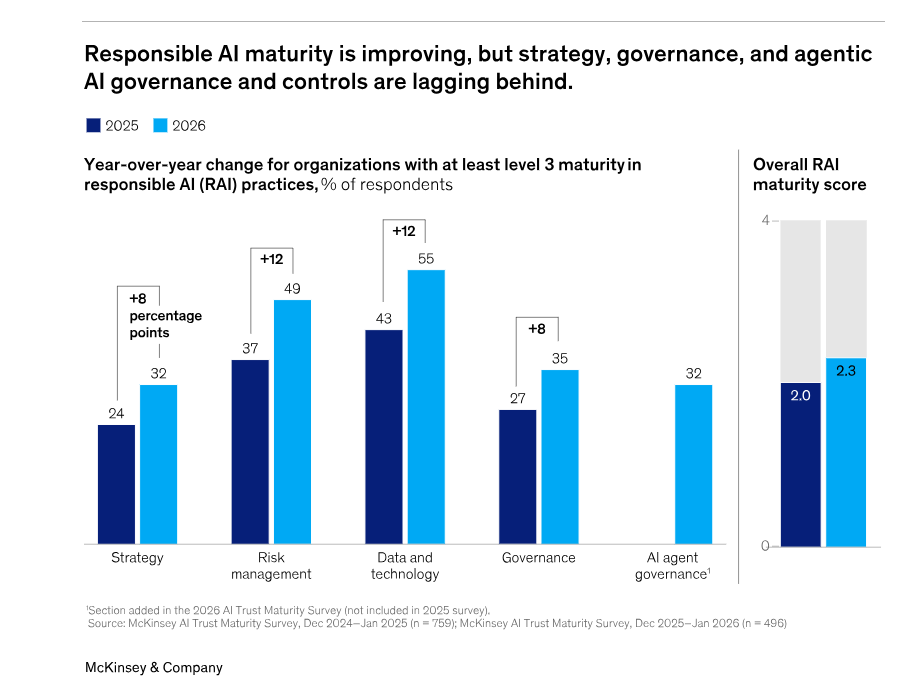
While businesses are rapidly adopting AI agents, responsible AI practices are still evolving. The latest McKinsey AI Trust Maturity Survey shows that organizations have improved in areas such as strategy, risk management, and data practices. However, governance for AI agents still has significant room for improvement. Have a look at the data from Mackinsey.
Industries Already Using AI Agents
AI agents are no longer limited to technology companies. Businesses across industries are already finding practical ways to use them.
1. Customer Support
Instead of answering only basic questions, AI agents can:
● Resolve complaints
● Process refunds
● Schedule appointments
● Update CRM records
● Escalate complex cases to human agents
This is why, companies are now building customer service agents that work around the clock. AI-powered tools like Janitor AI show how conversational agents are already handling real user interactions at scale.
2. Healthcare
Hospitals and healthcare providers are testing AI agents to:
● Summarize patient records
● Schedule appointments
● Assist doctors with documentation
● Verify insurance details
● Monitor patient follow-ups
McKinsey reports healthcare as one of the leading sectors experimenting with AI agents.
3. Manufacturing
Factories use AI agents to:
● Predict machine failures
● Monitor equipment
● Order replacement parts automatically
● Optimize production schedules
Instead of waiting for a machine to break, AI agents identify warning signs early.
4. Finance
Banks and financial institutions are deploying AI agents for:
● Fraud detection
● Loan document verification
● Risk analysis
● Compliance reporting
● Customer onboarding
These processes traditionally required several employees and many manual checks.
5. Retail and E-commerce
Online stores use AI agents to:
● Forecast demand
● Update inventory
● Recommend products
● Personalize promotions
● Track deliveries
The result is faster operations and better customer experiences.
6. Real Companies Already Benefiting
Businesses are moving beyond pilot projects.
For example, chemical manufacturer Dow built AI agents using Microsoft Copilot Studio to review more than 100,000 shipping invoices every year. The agents identify billing errors within minutes instead of weeks, and the company expects to save millions of dollars through improved logistics accuracy.
Similarly, energy provider Eneco is using AI agents to improve customer service and business operations. Microsoft highlights these examples as proof that AI agents are moving from experiments to real business value.
7. Even Traditional Industries Can Benefit
Many people think AI agents only help software companies. That is far from true. Construction firms can automate project documentation. Law firms can summarize contracts. Logistics companies can coordinate deliveries.
Insurance providers can process claims faster. Even custom metal garage suppliers can use AI agents to qualify leads, generate quotations, answer customer questions instantly, schedule consultations, and follow up with potential buyers automatically, allowing sales teams to focus on closing more deals instead of handling repetitive administrative work.
How AI Agents Are Transforming Business Departments
AI agents are not replacing entire businesses. Instead, they are taking over repetitive work that slows employees down. This allows people to spend more time on creative thinking, problem-solving, and customer relationships.
Here are some of the biggest areas where AI agents are making a difference.
Sales:
Sales teams spend hours researching prospects, sending follow-up emails, updating CRM systems, and preparing reports.
AI agents can:
● Find potential customers based on specific criteria
● Write personalized outreach emails
● Schedule meetings
● Update CRM records automatically
● Remind sales representatives about follow-ups
This helps sales professionals focus on building relationships rather than managing paperwork.
Marketing:
Marketing teams work with large amounts of data every day.
AI agents can:
● Analyze campaign performance
● Suggest content ideas
● Monitor competitors
● Generate weekly reports
● Recommend the best time to publish content
● Identify customer trends
Instead of spending hours collecting information, marketers receive ready-to-use insights.
Human Resources:
Hiring and employee management involve many repetitive tasks.
AI agents help HR teams by:
● Screening resumes
● Scheduling interviews
● Answering employee questions
● Creating onboarding checklists
● Tracking training progress
This improves the hiring process while reducing administrative work.
Finance:
Finance departments require accuracy and speed.
AI agents can:
● Match invoices with purchase orders
● Detect unusual transactions
● Generate financial summaries
● Track budgets
● Prepare compliance documents
Human experts still review important decisions, but AI agents reduce manual effort significantly.
The Rise of Multi-Agent Systems
One of the biggest trends in business automation is the use of multi-agent systems. Instead of relying on one AI agent, businesses create multiple specialized agents that work together.
For example, imagine an online furniture company.
One AI agent receives the customer order. A second agent checks inventory. A third agent arranges shipping. Another agent updates the customer with delivery information.
Each agent has a specific responsibility, but together they complete an entire business process without constant human involvement.
According to Deloitte, many organizations are moving toward Agentic Process Automation (APA), where AI agents and robotic process automation (RPA) work together to automate more complex business workflows than traditional automation could handle.
Benefits Businesses Can Expect
Companies investing in AI agents are looking beyond cost savings. Some of the biggest benefits include:
1. Faster Decision-Making: AI agents analyze information within seconds and recommend the next action quickly.
2. Higher Productivity: Employees spend less time on repetitive tasks and more time on valuable work.
3. Better Customer Experience: AI agents provide faster responses, personalized recommendations, and consistent support throughout the day.
4. Lower Operational Costs: Businesses can automate routine work without hiring additional staff for every growing workload.
5. Improved Accuracy: AI agents reduce common manual mistakes in data entry, reporting, scheduling, and documentation.
6. Continuous Operations: Unlike human teams, AI agents can operate 24 hours a day without interruptions.
Challenges Businesses Should Prepare For
Although AI agents offer impressive benefits, they also introduce new challenges.
● Data Privacy
AI agents often access customer information, financial records, and internal documents. Businesses need strong security policies to protect sensitive data.
● Human Oversight
AI agents should not make every decision independently. Important business decisions should always include human review.
● Integration with Existing Systems
Many companies use multiple software platforms. Connecting AI agents with older systems can require additional planning and technical expertise.
● Employee Training
Employees need to understand how to work alongside AI agents instead of seeing them as replacements. Organizations that provide proper training usually experience smoother adoption.
Best Practices for Successful AI Agent Adoption Businesses that achieve the best results usually follow a gradual approach.
1. Start with One Business Process: Choose a repetitive task such as customer support, invoice processing, or report generation.
2. Measure Results: Track improvements in productivity, response time, customer satisfaction, and operating costs.
3. Expand Slowly: Once one AI agent proves successful, introduce additional agents for other business functions.
4. Keep Humans in Control: AI agents should support employees, not replace critical thinking and business judgment.
McKinsey notes that while AI adoption is growing rapidly, many organizations still struggle to scale AI successfully because they focus on isolated tools instead of redesigning business workflows around AI.
What Does the Future Look Like?
The next few years will likely bring even smarter AI agents.
Future AI agents may:
● Collaborate with other agents across different companies
● Manage complete business operations with minimal supervision
● Continuously improve through real-time learning
● Support employees with proactive recommendations instead of waiting for instructions
Deloitte estimates that one-third of enterprise software applications are expected to include agentic AI capabilities by 2028, while the global agentic AI market could reach $103.6 billion by 2032.
These predictions show that AI agents are not just another technology trend. They are becoming an important part of how businesses will operate in the future.
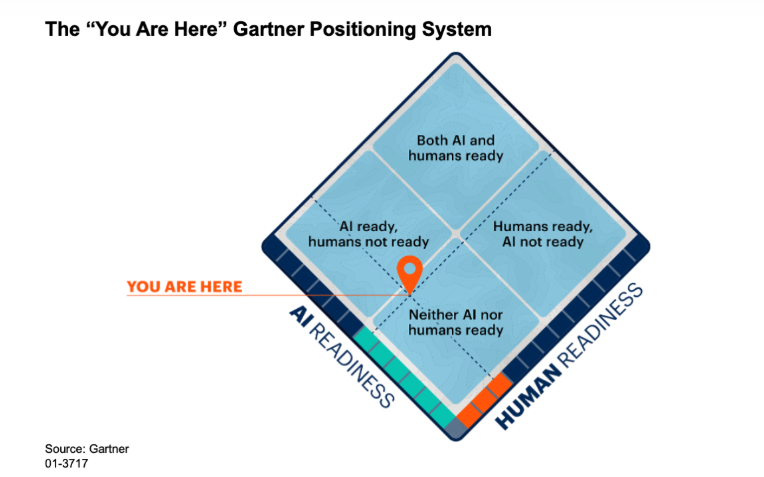
As AI agents become more common, success depends on both technology and people. Gartner’s framework shows that many organizations are still in the early stages of AI readiness and workforce preparedness. Businesses that improve both are more likely to achieve successful AI-driven transformation.
Have a look at the image below, its a Gartner’s “You Are Here” Positioning System. It shows that many organizations are still in the early stages of AI and human readiness. Businesses that strengthen both dimensions are better positioned to achieve successful AI-driven transformation.
Conclusion:
Business automation has evolved from simple rule-based software to intelligent systems that can understand goals, make decisions, and complete complex workflows. AI agents represent the next stage of this evolution. They help businesses improve productivity, reduce repetitive work, enhance customer experiences, and support employees rather than replace them.
Whether it is customer service, manufacturing, finance, healthcare, logistics, or retail, organizations are already seeing measurable benefits from AI agents. The companies that start experimenting today, build strong governance, and combine AI with human expertise will be better prepared for the future of work.
Rather than asking whether AI agents will change business automation, the more important question is how businesses can adopt them responsibly to create long-term value.